
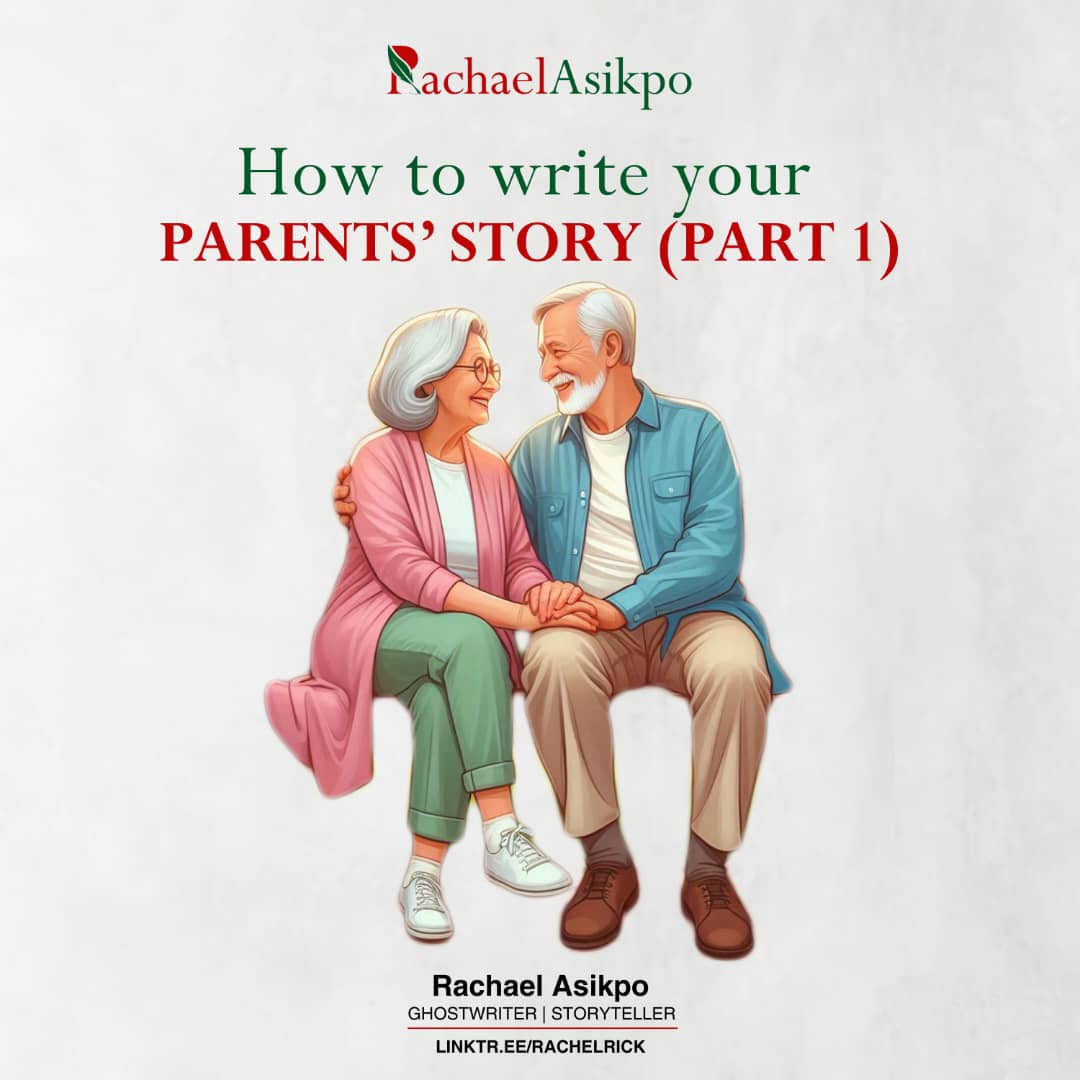

Recently, I was thrilled to find an old photo of my parents. They looked so happy in each other’s arms as they smiled at the camera, like something out of a movie. My dad looked like a young Soul brother, donning a plump Afro while wearing a vintage shirt unbuttoned at the collar, and Jeans. My mom was petite and flashy in her cropped blouse and palazzo jeans, as she rested her head on his shoulder. They looked so young and at ease with life that I wondered about such a time. So, out of curiosity, I asked about the picture, and my mum began recounting how she had met my dad…
Does this experience strike a similar chord? Do you remember finding a keepsake from the past and wanting to hear the story behind it?
If you are like me, you must have asked questions, and by asking questions, you must have realized there is so much more to the people you call dad and mom: achievements, experiences, hopes and dreams!
As reflective beings, humans seek to preserve memories of important moments and experiences by taking photos, souvenirs, mementos, or even writing about them in diaries or journals. Behind every keepsake is a story to be told, and an experience to be remembered. But more importantly, these stories help us learn more about ourselves: how different ordeals shaped the characters of our loved ones and how these changes affected us. For example, why did my father have a towering collection of jazz music? Because he once tried his best to become a jazz player, but unexpected responsibilities whisked his dreams away by the time he finished secondary school. Could this be the reason why I spent most of my childhood listening to jazz music, played every day, and on every family trip with him? I was so immersed in the genre that I grew to love his music as well.
In the greater picture, learning about the past of our predecessors can also deepen our understanding of culture, heritage, and identity. And by knowing the past, we can forge a better way to live life forward. I could have decided to achieve the goal my father once had. Who knows, I could be struggling with indecision at a crossroads between music and something else. But learning about my father’s passion or regret might have been the encouragement I needed to follow my heart. You would be surprised by all the things you could learn from your parents’ decisions — knowing what they tried, how they tried it, and how they failed is the best way to make choices as their successor.
Why should you tell their story?
As our Parents get older, they tend to forget the stories of their lives for scientifically explained reasons ranging from age-related decline to stress. Additionally, the brain’s prioritization of recent or more emotionally significant memories over older ones can contribute to the fading quality of stories over time. Memories tend to lose pieces of information as we grow older, leaving only a few vivid details. This would mean that for every story your loved one carries, it is only a race against time before it is partially or completely lost. You can read more about this here.
In the process of writing your parents’ stories, you not only get them to relive essential moments, but you also get to connect with them on a deeper level as they take that retrospective journey. Here are some reasons why you should tell their story:
• Corroborate History:
Everyone experiences at least one significant instant in history throughout their lifetime, and to each important event, there is a unique perspective. Furthermore, our parents’ stories can offer a window into historical events such as societal changes and cultural shifts. If there is one way to recount history, it is certainly by telling it in the first person, because you can portray how these events impacted families and individuals intimately. Your parents’ story could be the bridge between the present and the past because of the wealth of experiences embedded in it. By preserving their story, you would be holding up a beacon for generations hereafter.
• Preserve Family Legacy:
This is a common pain point for most authors seeking to preserve their family’s history. There is an imminent danger of the loss of a family’s legacy if no one records key acts and events by significant members. Take the Bible, for example, both the Old and New Testaments are primarily records of revered figures in the Christian faith and their actions in the past. More than 2000 years since its earliest books were written, the book remains relevant to the Christian faith until today. It would be a nice addition to note that Bible stories were also passed down through families both orally and in written format. So, when the record of one’s life is not handed down to the next generation, the legacy of that family slowly sifts away with time.
Writing a book would be a great way to preserve the remarkable feats of your parents that are a part of the family legacy. Also, by writing a book about your family’s legacy, you quell the urgent need to control the narrative about what your family represents and who your parents were. It is the knowledge preserved that will stand the test of time, not rumor or conjecture. You can be that person who helps to keep your family’s identity alive by keeping a record of your parents’ lives.
• To Understand your Roots:
An individual is shaped by a confluence of factors from their childhood into adolescence. To reflectively understand why a person behaves the way they do, you must investigate these factors, whether negative or positive. Moreso, by hearing our parents’ stories, we capture snippets, clues, and revelations steeped in the past lives of our grandparents and great-grandparents. By sharing memories from their lives, your parents might expose details about a grandparent or late relative that will give insight into present family issues.
Identity is Preserved in History:
It is a noble endeavor to want to tell your parents’ story, and my reason for writing this article is that I have come across a few clients who sincerely could not afford a professional ghostwriter and still needed the urgent service of preserving their parents’ stories. Preserving our history is a perpetual mandate that must continue with every generation. It is how we induct younger generations into the family’s identity and goals.
I truly believe this article will inspire someone to take responsibility for capturing their family’s legacy and provide guidance on how to achieve it. As this article is continued in a following part, you may come to understand the meticulous art that goes into writing a life story, and if you are determined, you may be able to use your resources to create an impactful record of a life well-lived.
However, if you worry you may not be skilled enough to achieve this on your own, you may still consider hiring a ghostwriter. Why? You are not only trying to preserve the essence of a life lived for others to hold in their hearts, but you are also holding up their legacy to scrutiny, and you do not want to undermine your message either by poor writing or structuring.
Only a devoted writer can invest sufficient time and skill in bringing out the absolute best of the story, because it will be a time capsule to be revisited by several related individuals. You want these subsequent readers to have an inspiring story when they read the book; they should be able to feel emotion and be led to thought as they imagine your parents’ experiences.
My name is Racheal Asikpo. As a Memoir and Autobiography ghostwriter with a decade of experience, I am passionate about how stories impact lives and change futures. When I work with aspiring authors, I seek to immerse myself in the writing process to realize the best delivery of their voice in their story.
As a science fiction and fantasy ghostwriter, I enjoy plunging into challenges of unboxed imagination, creating thought-provoking journeys for readers.
You can learn more about me from my Linktree.
I also write episodic shorts on my Substack, you can subscribe for more!
I look forward to hearing from youm you
[…] is Part 1 in case you haven’t read […]